

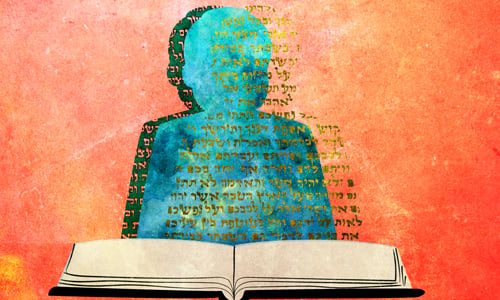
A beit midrash (בֵּית מִדְרָשׁ), literally “house of study,” or “study hall,” is the traditional Jewish space devoted to Torah study. Its name comes from the Hebrew root דרש, meaning “seek” or “delve,” reflecting its purpose as a place where Torah is questioned and explored. Throughout Jewish history, the beit midrash has been the heart of Jewish intellectual and spiritual life, filled with the vibrant, at times cacophonic, sound of learning.
Is It the Same as a Synagogue?
Although many Jewish buildings house both a study hall and a synagogue, the beit midrash and beit knesset serve distinct roles. A beit knesset is principally a house of prayer; a beit midrash, on the other hand, is oriented around Torah study and discussion. Both are referred to as a “mikdash me’at”—a miniature sanctuary—by the Talmud.1
In practice, many community spaces—and historically, many synagogues—function as both a beit midrash and beit knesset, hosting prayer services as well as full-time learning. For this reason, some synagogues are actually named beit midrash, and some congregations refer to their smaller sanctuary, used for weekdays, as the beit midrash.
Nevertheless, Jewish law still distinguishes their functions, and in certain legal contexts the beit midrash is considered to possess a higher degree of sanctity.2
The Great Study Halls
Throughout the centuries, the great batei midrash (plural of beit midrash) became the engines of entire eras of Torah scholarship. In Talmudic times, the great Babylonian academies of Sura, Pumbedita, and Nehardea produced the teachings that would form the Babylonian Talmud, with towering figures such as Rav, Shmuel, Rabbah, Rava, and Abaye shaping its discussions. After the close of the Talmud, the academies of Sura and Pumbedita continued to function as the central institutions of Torah learning throughout the Geonic period, lasting approximately until the death of Hai Gaon in 1038, which effectively marked the end of that era. Earlier centers in the Land of Israel—Jerusalem, Yavneh, Beit Shearim, Tzippori, and later Tiberias—served as the successive homes of the Sanhedrin and the redaction of the Mishnah and the Jerusalem Talmud.
As Jewish scholarship flourished across the Islamic world, major Sephardic centers emerged. In 11th-century Granada, the beit midrash of Shmuel HaNagid (Shmuel ibn Naghrillah), who served both as a statesman and as a leading Torah scholar, became one of the most vibrant academies of its time, producing great works of halachah and Hebrew grammar. In North Africa, the Kairouan Yeshiva produced figures such as Rabbeinu Nissim Gaon (Ran of Kairouan, 11th cent.), Rabbeinu Chananel (Chananel ben Chushiel), the Rif (Isaac ben Jacob Alfasi), continuing the Geonic intellectual legacy. By the late 12th century, another monumental center emerged in Provence and Spain with the Ramban (Rabbi Moshe ben Nachman, 1194–1270), whose beit midrash in Girona shaped generations of scholars; after his arrival in Jerusalem in 1267, he reestablished a beit midrash there, marking the first renewal of organized Torah study in the Holy City after centuries of decline.
Around this time, during the 12th–13th centuries, the study halls of the Baalei Tosafot in the Jewish communities of France and Germany—rooted in the beit midrash of Rashi in Troyes (1040–1105), which shaped many of the early Tosafists—developed an intensive analytical method that became the backbone of Talmudic study and remains indispensable today. Among the foremost figures were Rabbeinu Tam, Rashbam, Rabbeinu Yitzchak of Dampierre (Ri HaZaken), Rabbeinu Peretz of Corbeil, and Rabbeinu Eliezer of Touques (13th cent.)
Your Beit Midrash
“There is no beit midrash without a new insight,”3 the Talmud declares. Whenever Jews gather to learn, some form of chidush—a fresh understanding, a clearer explanation, or a new layer of depth—will inevitably emerge.
A beit midrash carries a unique spiritual stature because the Divine presence rests wherever Jews gather to learn Torah. “When two sit together, and words of Torah are between them, the Shechinah is present,”4 the Talmud promises. The Midrash adds an even more intimate dimension: “Every time a person studies Torah, the Holy One reads and learns opposite him.”5 The beit midrash is a place where the Divine presence becomes tangible through the act of learning, a living continuation of the revelation at Sinai.


Start a Discussion